

Trusted Foundation Repair Company Serving Longview, TX
Cracked slabs, sticking doors, and windows that fight you every morning all point in the same direction. East Texas Slab Masters is here to help. Our Longview foundation repair company reads the damage first, then picks the fix your property actually needs.
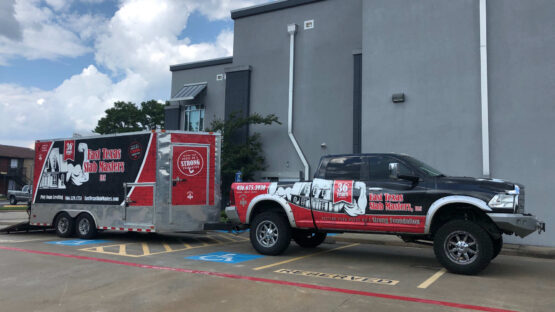
Foundation movement is routine across East Texas. The clay soil in and around Gregg County swells when it takes on water. It shrinks back during dry stretches. That cycle pulls on a foundation year after year. Newer construction adds to the problem as the structure settles into place. When the movement keeps going instead of settling down, the foundation needs reinforcement from a qualified foundation repair company in Longview. The methods below cover the approaches we use most often and the conditions each one is suited to.
Pier Pilings
Pier pilings correct Longview homes and their problems along the inside and outside of a foundation. They work on slab homes and pier-and-beam homes alike. Our crews set pressed concrete piers at load-bearing points around the perimeter. A hydraulic machine drives each one roughly 12 feet into the soil. The piers are six-inch concrete cylinders stacked to depth. Once they are in place, the structure transfers its weight onto the piers rather than resting entirely on the surface soil. That depth matters for East Texas homes. The top few feet of ground shift with the weather, but the material further down holds steadier.
Polyurethane Injection
In many cases, the instability sits only in the upper soil layer. The top layer of ground under a home can swell and shrink too much to carry the load. A geopolymer injection corrects that without excavation. Our foundation repair company helps Longview properties by injecting the material at fixed points beneath the slab, where it expands and firms up the soil. Compared with driving piers or opening up the foundation, the process disrupts far less of the property, and the result holds up over time.
Drilled Bell Bottom Piers
Bell bottom piers, also called belled piers, take their name from their shape. The base is much wider than the shaft. That spreads the load across more soil and gives the pier extra resistance to movement. Our foundation repair company serving Longview forms them on site by drilling the shaft, excavating a wider void at the bottom, and pouring concrete into the cavity. Most include a steel reinforcing rod through the center for extra strength.
Moisture Containment Barriers
A moisture containment barrier is mainly preventive, though crews can add one after repairs are complete. Sheets of specialty plastic run vertically along the foundation and extend past its bottom edge, slowing the rate at which groundwater reaches the soil underneath. Homes that sit on poor drainage or take on heavy runoff during East Texas storms benefit most from this approach. It is not the same as a vapor barrier, which sits beneath the slab and shields the concrete itself from moisture.
Retaining Wall
Not all foundation stress originates below the structure. Sloped lots, erosion, and washouts apply lateral pressure that can crack or displace a foundation over time. For properties near a creek or a steep grade, our crew serving Longview builds a retaining wall that holds the surrounding soil in position. That takes the pressure off the foundation edge.
Your Foundation Repair Experts
Foundation damage does not correct itself, and the cost of the fix climbs the longer it waits. Our Longview foundation repair company will assess the condition of your foundation and identify the soil and drainage factors behind it. We then recommend the methods that fit your property. East Texas Slab Masters has served Longview, Gladewater, White Oak, Kilgore, Lakeport, and all of Gregg County for over 20 years. Contact us to schedule a no-obligation assessment.